
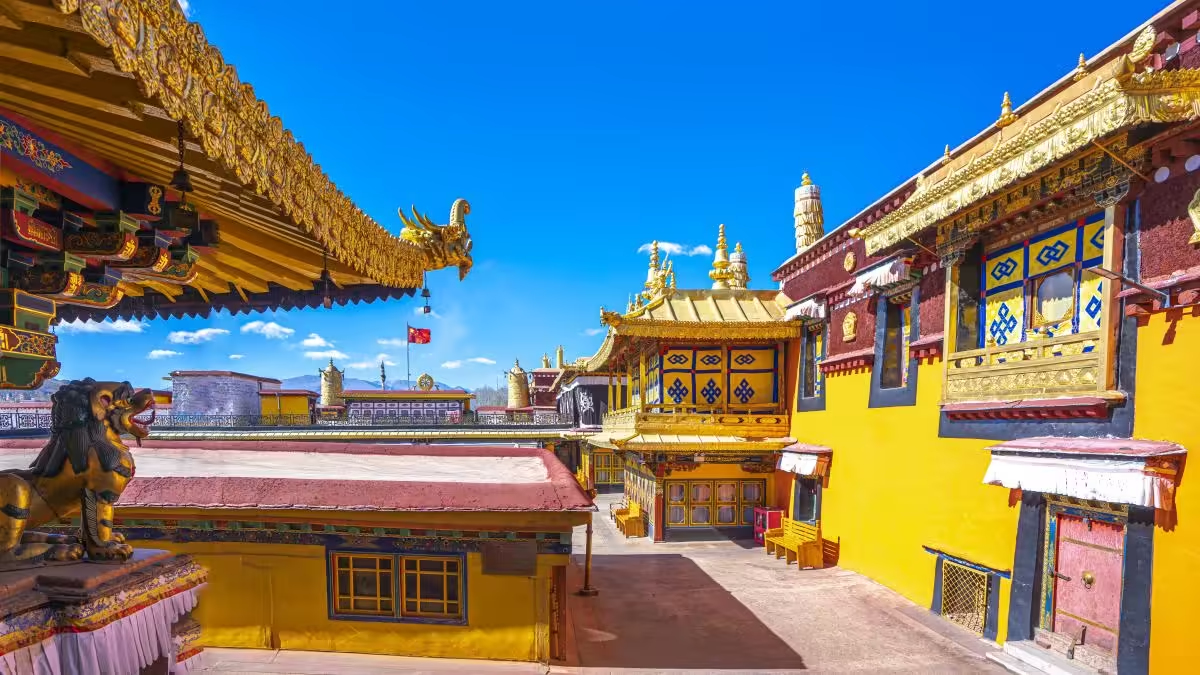
Jokhang Temple (Dazhao Temple, 大昭寺), located in the heart of Lhasa’s old town, is a prominent Tibetan Buddhist monastery. Originally known as “Re Sa,” the name later evolved to refer to the city itself, which became “Lhasa.” The temple has undergone numerous modifications and expansions throughout the Yuan, Ming, and Qing dynasties, resulting in its current impressive scale.
With over 1,300 years of history, Jokhang Temple holds a supreme position in Tibetan Buddhism. It is the most magnificent example of architecture from the Tubo period and is recognized as the earliest earthen structure in Tibet. The temple pioneered the layout of Tibetan-style temples, featuring a central hall dedicated to Sakyamuni Buddha, surrounded by a circular walkway known as “Nangkhor.” The outer circuit is called “Barkhor,” while the larger circuit encompassing the Potala Palace, Yao Wang Mountain, and Xiaozhao Temple is referred to as “Lin Khor.” These concentric pathways serve as the route for Tibetan pilgrims performing kora (circumambulation) around the temple.
Jokhang Temple showcases a blend of architectural styles from Tibet, Tang China, Nepal, and India, making it a timeless exemplar of Tibetan religious architecture. The temple is perpetually filled with incense, and the stone floor bears deep imprints from the devoted prostrations of countless worshippers. The light from thousands of butter lamps illuminates the temple, leaving a lasting testament to the passage of time and the faith of pilgrims.
Table of Contents
- Basic Information
- Location and Transportation
- Highlights of Jokhang Temple
- Legends of Jokhang Temple
- History of Jokhang Temple
Basic Information
| Estimated Length of Tour | 2 – 3 hours |
| Ticket Price | 85 RMB |
| Opening Hours | 8.30 – 18.30 |
| Telephone Number | 0086-0891-6336858 |
Location and Transportation
Jokhang Temple is located at No. 2 Barkhor West Street, Chengguan District, Lhasa, Tibet Autonomous Region, China. To get there, you can take bus 7, 8, 14, 20, 25, 28, 29, 32, 33, K04, or W01 and get off at Chongsaikang Stop (冲赛康站).
Highlights of Jokhang Temple
Maitreya Buddha Hall

The main deity of the Maitreya Buddha Hall is a small yet exquisite statue of Maitreya Buddha. Traditionally, during the annual grand prayer ceremony, this statue would be paraded along Barkhor Street. Flanking the Maitreya statue are two bodhisattvas: Manjushri on the left and Avalokiteshvara on the right, with a statue of Green Tara in a seated posture beside each. Four wrathful guardian deities are positioned along the walls, serving as protectors of the hall. To the right of the entrance stands the Dhritarashtra (one of the Four Heavenly Kings), while to the left is Zambala, the God of Wealth. The altar features a statue of Jetavam Lama, who built a dam in Lhasa to prevent flooding. If you look closely in the lower left corner of the hall, you’ll find a small stone goat, known as the sacred goat that legend says filled the lake of Wotang with earth.
Avalokiteshvara Hall

In the Avalokiteshvara Hall, the main figure is a small statue of Avalokiteshvara riding a lion (the first statue on the left), rather than the large Amitabha Buddha. The remaining five statues represent different manifestations of Avalokiteshvara. Between this hall and the stairs leading to the upper level stands a pillar with a hole at the top. Many pilgrims press their ears against this hole, hoping to hear the sound of a duck flapping its wings, as it is said that this duck resides at the bottom of the lake in Jokhang Temple.
Three Dharma Kings Hall

The main deity of the Three Dharma Kings Hall is King Songtsen Gampo of Tibet, with King Trisong Detsen on the left and King Langdarma on the right. These three kings ruled during the height of the Tubo Dynasty, and their strong support allowed Buddhism to flourish and develop in Tibet. They are historically recognized as the three Dharma Kings of Tibet and are traditionally referred to as the “Three Dharma Kings of Ancestors and Descendants.”
Green Tara Hall

The Green Tara Hall is dedicated to the bodhisattva Tara. The central statue represents Tara, and behind her, in a glass cabinet, is a depiction of her primary manifestation, the “Twenty-One Taras.” To the right of the altar, there are six additional statues. The first three are known as the “Three Gurus,” which include Je Rinpoche, Padmasambhava, and King Trisong Detsen. The remaining three are the “Three Disciples,” featuring Tsongkhapa and his two major disciples, Khedrup Je and Gyaltsab Je.
Tangbo Alliance Monument

As you enter the small square in front of Jokhang Temple, you can view the temple in its entirety. The first thing that catches your eye is the two stone tablets enclosed by a wall. The southern tablet is the famous Tangbo Alliance Monument, measuring 3.42 meters high, 0.82 meters wide, and 0.35 meters thick. It is inscribed in both Tibetan and Chinese characters, dating back to the third year of the Tang Changqing period (823 AD).
In the 9th century, the Tang Dynasty and the Tubo Dynasty established a peace agreement to ensure that “neither would act as enemies nor wage war,” aiming to provide stability for the people and to maintain friendly relations. To symbolize the enduring friendship between the two nations, King Tride Songtsen erected this monument in front of Jokhang Temple. The inscription is simple yet heartfelt, and despite weathering, most of the text remains legible. Beside the monument stands a willow tree, said to have been planted by Princess Wencheng, referred to locally as the “Princess Willow.”
Tsongkhapa and His Eight Disciples Hall

This hall is dedicated to Tsongkhapa, the founder of the Gelug school of Tibetan Buddhism. The central statue depicts Tsongkhapa, flanked by eight statues of his principal disciples. Among them, Khedrup Je and Gyaltsab Je stand to his left and right, respectively. During Tsongkhapa’s later years, when he retreated to a remote cave for meditation, these eight disciples were by his side, serving him. While Tsongkhapa was alive, his disciples commissioned several statues of him, and upon seeing one, he remarked on its remarkable resemblance to himself. Behind the statue of Tsongkhapa, on the left side, is a row of statues representing his Sakya lineage teachers. The Fa Lun Hall at Yonghe Temple in Beijing also honors this great master.
Amitabha Hall

The entrance to this hall is guarded by two fierce protective deities: on the left is the blue Vajrapani, and on the right is the red Mahākāla, one of the manifestations of the deity with a horse’s head, known as Chodai Mewa Tsigapa. Inside the hall, the main statue is Amitabha Buddha, flanked by two smaller fierce protective deities. The walls are adorned with four seated Buddha statues in meditation posture. This hall is sometimes referred to as the “Hall of Karmic Obstacles,” as it is situated adjacent to the Shakyamuni Hall, where devotees pray to remove any obstacles in their worship of Shakyamuni Buddha.
Cultural Relics

Jokhang Temple houses a wooden door frame dating back to the 7th century, along with intricate carvings above it. Additionally, in front of the Shakyamuni Hall, there are eight wooden pillars from the same period. In 2000, Jokhang Temple was designated a UNESCO World Heritage Site, and one of the key factors for this recognition was the presence of these wooden carvings, which cannot be found in any other Tibetan temple. After 1,400 years, these carvings have become as hard as iron, producing a metallic sound when struck.
Among its treasures is the 12-year-old statue of Shakyamuni Buddha, sculpted in the likeness of the Buddha during his lifetime. After the statue was completed, it is said that the Buddha himself performed the consecration. This statue is particularly valuable not only for its historical and cultural significance but also because it is believed to provide a direct connection to the Buddha as he was 2,500 years ago.
Legends of Jokhang Temple
Legend 1: According to one legend, the site of Jokhang Temple was once a vast lake. It is said that King Songtsen Gampo promised Princess Wencheng, the Nepalese princess, that he would build a temple where her ring fell. To their surprise, the ring landed in the lake, causing the surface to shimmer with light, revealing a nine-tiered white stupa. This event sparked a monumental project where a thousand white goats were used to carry earth for the construction of the temple.
Legend 2: Another tale tells of two princesses who each brought a precious statue of Shakyamuni Buddha as part of their dowries. The Nepalese princess brought an eight-year-old statue of Shakyamuni, while Princess Wencheng brought a twelve-year-old statue from Chang’an. These two statues are recognized by the Tibetan people as the first Buddhist images to enter the Tibetan Plateau. To honor these sacred statues, King Songtsen Gampo initiated the construction of the earliest Buddhist structures in Tibetan history, which became Jokhang Temple and the smaller Zhaocang Temple.
Legend 3: Another legend tells that during the construction of Jokhang Temple, the site was repeatedly flooded. Princess Wencheng explained that the entire Qinghai-Tibet Plateau resembled a reclining female demon, with her head facing east and legs facing west. The lake where Jokhang Temple stands was said to be the heart of this demon, with the water representing her blood. To build the temple, Princess Wencheng insisted that the lake must be filled to subdue the demon’s heart.
In addition, she recommended the construction of twelve smaller temples in remote areas to restrain the demon’s limbs and joints, resulting in a total of thirteen temples. The construction began by filling the lake, primarily using goats to carry bags of sand and earth. This effort laid the foundation for Jokhang Temple.
The name “Lhasa” itself evolved from Jokhang Temple. Originally, Lhasa was not called “Lhasa” but was recorded as “Rasa” in ancient texts, where “Ra” means goat and “Sa” means land, signifying “the place built by goats.” As the temple was constructed, housing sacred statues, scriptures, and attracting pilgrims from all directions, it became regarded as a holy site, leading to the name change to “Lhasa.” In Tibetan, “La” means Buddha and “Sa” means place, emphasizing its significance as a sacred ground.
History of Jokhang Temple
Jokhang Temple was founded during the peak of the Tubo Dynasty in the 7th century, originally built to house a statue of Sakyamuni Buddha as an eight-year-old, brought to Tibet by Princess Bhrikuti of Nepal, who married the Tubo King Songtsen Gampo. The construction lasted over three years, and the temple was initially named “Re Sa” to commemorate the white mountain goat, with “Re” meaning “goat” and “Sa” meaning “earth” in Tibetan. It was later renamed “Zulakhang” (the scripture hall) and “Juekang” (the Buddha hall), with the full title meaning “the hall built by a goat carrying earth.”
Throughout its history, Jokhang Temple faced two major calamities. The first occurred in the late 7th century when a ban on Buddhism was initiated by nobles adhering to the Bon religion, leading to the temple’s closure and transformation into a slaughterhouse. The second ban was instigated by Langdarma in the mid-9th century, which also resulted in the statue of Sakyamuni being buried underground.
In 1409, Tsongkhapa, the founder of the Gelug school, organized a grand prayer ceremony at the temple to honor Sakyamuni’s merits, after which it was officially renamed Jokhang Temple. This event marked a significant revival of the temple’s religious importance in Tibetan Buddhism.
