

The Tianyi Pavilion Museum, or Tianyige Museum (天一阁博物院, Tianyi Pavilion Library), located in Ningbo City, was constructed during the mid-Ming Dynasty under the supervision of Fan Qin, a former right assistant minister of the Ministry of War who retired at the time. It stands as the oldest existing private library in China, as well as one of the oldest libraries in Asia and one of the earliest among the world’s three major family libraries. Many of its exhibition halls showcase the extensive collection of books gathered by the Fan family from all corners of the country.
Covering an area of approximately 34,000 square meters, the Tianyi Pavilion Museum houses a diverse array of artifacts, including ancient texts, calligraphy, stone inscriptions, various unearthed and handed-down ceramics, bronzes, jade articles, and local craftworks. As of 2019, the museum’s collection comprises nearly 300,000 volumes of ancient books, with a significant portion being historical materials such as local chronicles and examination records, including over 80,000 rare editions. The most precious items in the collection are local chronicles and examination records from the Ming Dynasty, totaling 271 and 370 kinds, respectively. Additionally, Tianyi Pavilion Museum features an intriguing Mahjong Museum, which has become a popular spot for visitors to take photos and create lasting memories.
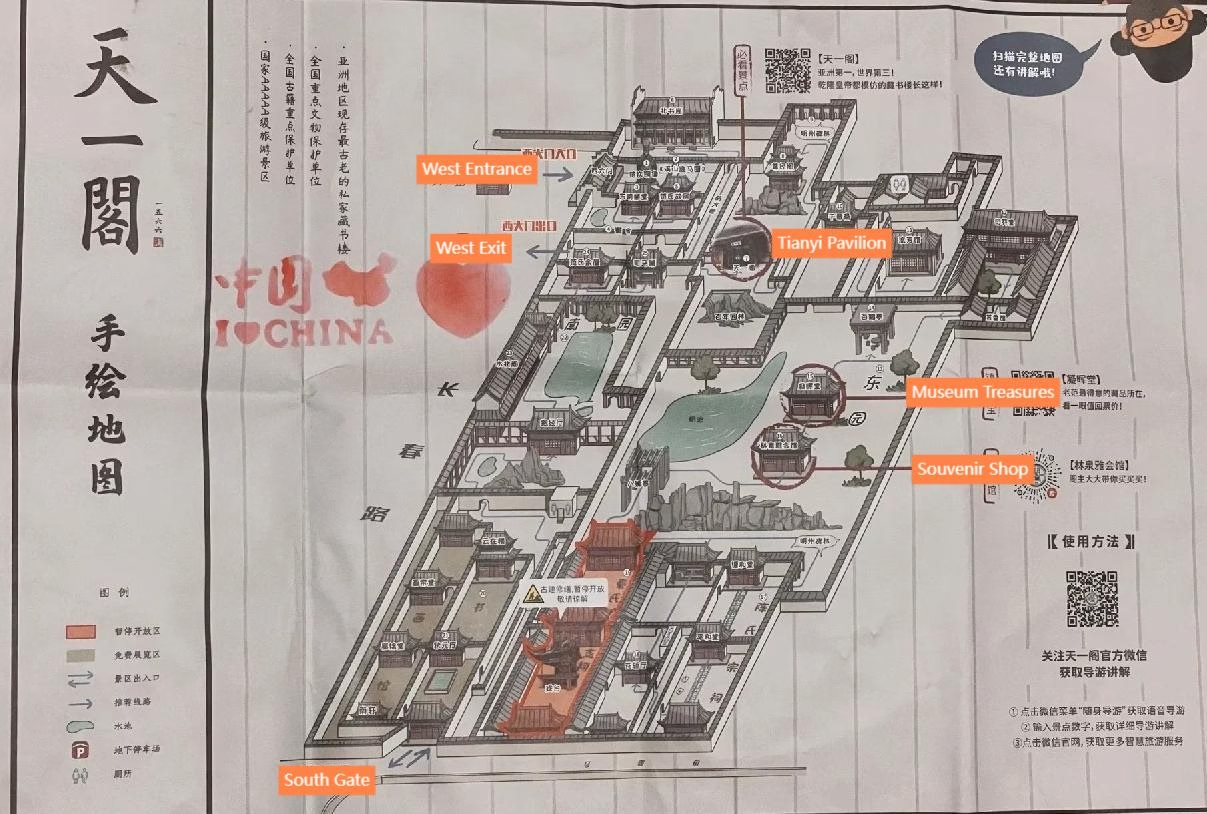
The museum is divided into three main areas: the book culture area, the garden leisure area, and the exhibition area. The book culture area centers around the Tianyi Pavilion Library, supplemented by the concentrated display of the Fan family’s remaining residences, including the Dongming Cottage, the Fan family’s former residence, the Zunjing Pavilion, the Qianjin Study, and the Baoshu Building. These are combined with dispersed displays at multiple points to present the exhibition content in stages. The exhibition area includes the Qin Family Branch Ancestral Hall, the Furong Isle, the Wen Family Ancestral Hall, and the newly built painting and calligraphy hall. Adjacent to the Qin Family Ancestral Hall is the painting and calligraphy hall, comprising six buildings: Yunzailou, Boya Hall, Zhuojintang, Hualiantang, Zhuangyuanting, and Nanxuan. Exhibited artifacts include ancient texts, calligraphy, stone inscriptions, various ceramics, bronzes, jade articles, and local craftworks. Within the garden leisure area, visitors can explore attractions such as the Ming Pond, artificial mountains, corridors, stone inscriptions, the Hundred Goose Pavilion, and the Ninghui Hall.
Basic Information
| Estimated Length of Tour | 2 hours |
| Ticket Price | 30 RMB |
| Opening Hours | 1st May – 31st October 8.30 – 17.30; Last admission: 17.00 (Tuesday – Sunday) 13.30 – 17.30; Last admission: 17.30 (Monday) 1st November – 30th April 8.30 – 17.00; Last admission: 16.30 (Tuesday – Sunday) 13.30 – 17.00; Last admission: 16.30 (Monday) |
| Telephone Number | 0086-0574-87293856 |
Map of Tianyi Pavilion
Location and Transportation
The Tianyi Pavilion Museum is located n the heart of Ningbo City. Its specific address is No. 10 Tianyi Street, Haishu District, Ningbo City, Zhejiang Province, China. To get there, you can choose one of the following ways:
Bus: Take bus 9, 26, 371, or 512 and get off at Tianyige Yuehu Lake Scenic Area Stop (天一阁·月湖景区).
Metro: The closest metro station to Tianyi Pavilion Museum is Ximenkou (西门口) on line 1. After getting out of the station from Exit D, walk about 450 meters to the south to reach the museum.



The Tianyi Pavilion in Ningbo is reasonably priced for admission and has a thoughtful design, making it worth a visit. My trip coincided with the Chinese New Year, and it was raining, which made it a bit crowded and rushed.
The wintersweet is in bloom at Tianyi Pavilion, quietly dominating the air of the entire garden. Above the library is a transparent tier, and below are six small rooms. I even got to see the origin of mahjong; the original tiles were so small!
Tianyi Pavilion in Ningbo truly possesses a unique cultural atmosphere. Among the ancient scholars, there were many lovers of books, but few could leave behind numerous beautiful tales simply through their collections.
The scenery in the garden is stunning, with elegant views that stand out, whether it’s the green bamboo, banana plants, or the ancient magnolias.
The nearby Moon Lake is particularly beautiful in the evening, with high-quality water. The evening glow is simply breathtaking!
The oldest existing library in the country, it is astounding to see the ancient people’s immense determination and their deep respect for culture.
I am forever captivated by the gardens of Tianyi Pavilion. They are absolutely stunning.
The summer heat was not as extreme as I had imagined. The park is filled with lush greenery, and the Su-style architecture is well-ventilated and cool. Areas like the Library Pavilion and multimedia halls have air conditioning, so if you’re sensitive to the heat, you can stay there a bit longer.
As a 5A tourist attraction, the size of Tianyi Pavilion seems quite small. It is roughly equivalent to the Wenlan Pavilion in the Gushan Museum at Gu Shan Park in a corner of West Lake in Zhejiang Province.
Limited parking spaces at the scenic area make it difficult to find a spot. It is recommended to drive a bit further and park at the nearby Wyndham Hotel where there are plenty of parking spaces available for a fee of 6 RMB for two hours. It’s a less than 10-minute walk to the northwest gate from there, and at the end of your visit, you can exit from the south gate which is closest to the parking lot.
Recently, the rainy season has come again. It’s uncomfortable to stay at home all day. So I decided to visit the Tianyi Pavilion to appreciate ancient books.
Upon arrival, I discovered that inside, there are winding paths leading to secluded spots, pavilions, towers, calligraphy inscriptions, and even a mahjong hall. I really enjoyed it.
First time seeing the Tianyi Pavilion Library
The Tianyi Pavilion Library is very beautiful, green all year round, suitable for visiting in all seasons.
Great for taking photos with reflections in the water.
Although there are tour route maps, it’s still easy to get lost without realizing it.