
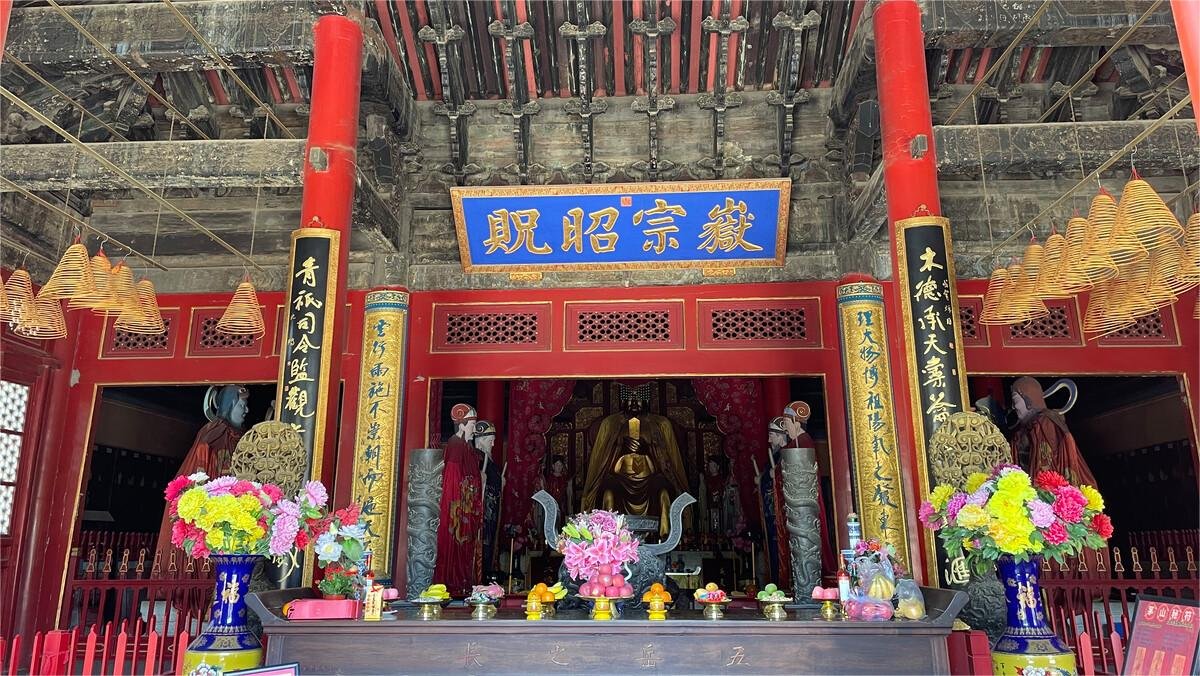
Dongyue Taoist Temple (东岳庙), located in Beijing, is a historic and culturally significant religious site that holds a prominent place in Taoist tradition. With a history dating back over 600 years, the temple stands as a testament to the rich spiritual heritage of China.
Situated in the Chaoyang District, Dongyue Temple is renowned for its exquisite architecture and tranquil surroundings. Its design embodies traditional Chinese temple aesthetics, featuring magnificent gateways, ornate pavilions, and beautifully landscaped gardens. The temple complex covers a vast area, with various halls, courtyards, and altars dedicated to different deities and Taoist beliefs.
Dongyue Temple holds a special significance for Taoists as it is regarded as the headquarters of the Beijing Taoist Association. Devotees and visitors flock to the temple to pay homage to various Taoist gods, seek blessings, and participate in religious rituals and ceremonies. The temple’s serene atmosphere provides a sanctuary for spiritual reflection and meditation amidst the bustling city.
Table of Contents
- Basic Information
- Location and Transportation
- Who is Enshrined in the Temple
- Highlights of Dongyue Taoist Temple
- Vlog about Dongyue Taoist Temple
- A Brief History of Dongyue Taoist Temple
- Useful Tips Summarized from Reviews
- Other Temples in Beijing
- Explore Beijing Like A Local
Basic Information
| Estimated length of Tour | 1 – 2 hours |
| Ticket Price | 10 RMB |
| Opening Hours | 8.30 – 16.30 |
| Telephone Number | 0086-010-65510151 |
Location and Transportation
Dongyue Taoist Temple is situated in the Chaoyang District, which is a bustling area in Beijing. Its exact address is No. 141 Chaowai Street, Chaoyang District, Beijing, China. To get there, you can choose the following ways:
Bus: Take bus 75, 101, 109, 110, 139, or 615, get off at Shenlu Street Stop (神路街站), and you will be standing right at the entrance of the temple.
Subway: The nearest subway station to Dongyue Taoist Tempel is Dongdajie (东大街) on line 6. After getting out of the station from Exit A, walk about 600 meters to the west to reach the temple.
Who is Enshrined in the Temple
In Dongyue Taoist Temple, the main deity who is enshrined and worshiped is the Taoist deity Dongyue Dadi, also known as the Great Emperor Dongyue. Dongyue Dadi is considered the chief deity of the Mount Tai (Dongyue) pantheon, which is a group of heavenly officials and earth deities in Taoism.
Dongyue Dadi is believed to govern and oversee the affairs of the earth, including human affairs, blessings, and protection. As the patron deity of Dongyue Temple, he holds a central position in the temple’s religious ceremonies and rituals.
The worship of Dongyue Dadi emphasizes virtues such as righteousness, justice, and morality. Devotees seek his blessings for prosperity, success, and well-being in various aspects of life, including career, health, and relationships.
Highlights of Dongyue Taoist Temple
Architectural Splendor

The Dongyue Temple complex showcases grand gateways, intricately carved stone pillars, and exquisite halls adorned with colorful paintings and ornate woodwork. Its traditional Chinese temple design, influenced by the Ming and Qing dynasties, reflects the craftsmanship and attention to detail of the era. The temple’s beauty lies in the harmonious blend of architectural elements, creating a serene and visually stunning atmosphere. Dongyue Temple stands as a testament to the rich architectural heritage of China and captivates visitors with its timeless grandeur.
Sacred Altars and Halls

Dongyue Taoist Temple in Beijing houses a series of sacred altars and halls that captivate visitors with their spiritual significance. Each hall is dedicated to specific Taoist deities and spirits, featuring elaborate sculptures, statues, and vibrant paintings that depict Taoist mythology and pantheons. The atmosphere is imbued with reverence and devotion as devotees pay their respects and seek blessings from these revered figures. The intricate details and artistic representations within the altars and halls offer a glimpse into the rich Taoist traditions and beliefs, inviting visitors to immerse themselves in the spiritual heritage of China.
Yuelao Shrine

The Yuelao Shrine within Dongyue Taoist Temple is a dedicated space honoring the Taoist deity Yuelao, also known as the God of Marriage and Matchmaking. This shrine attracts visitors seeking blessings for love, relationships, and successful marriages. Adorned with offerings, prayer plaques, and red ribbons symbolizing love and connection, the Yuelao Shrine creates an atmosphere of romance and hope. Devotees come to seek Yuelao’s guidance and intervention in matters of the heart, believing in his ability to bring forth harmonious unions.
Dongyue Temple Fair

During traditional festivals such as the Spring Festival, Qingming Festival, Dragon Boat Festival, Mid-Autumn Festival, and Double Ninth Festival, Beijing’s Dongyue Temple hosts a variety of traditional folk activities. The Dongyue Temple Fair is one of the oldest temple fairs in Beijing’s history and a typical representation of Beijing’s temple fairs.
The Dongyue Temple Fair has its origins in the Yuan Dynasty, took shape during the Ming Dynasty, and reached its peak in the Qing Dynasty. Since the establishment of Dongyue Temple in the Yuan Dynasty, the fair gradually formed around it, involving participation from both the emperor and common people. It encompasses a wide range of activities, including folk beliefs, commercial trading, and entertainment, making it a significant event in the community’s cultural life.
Vlog about Dongyue Taoist Temple
A Brief History of Dongyue Taoist Temple
Dongyue Temple in Beijing was founded during the Yuan Dynasty. In 1276, Taoist priest Zhang Liusun arrived in the capital and later decided to establish a temple dedicated to the Eastern Peak God, Dongyue Emperor. In 1319, he acquired land outside the city gate, but he passed away before construction began. His disciple, Wu Quanjie, continued the project, completing the main hall and entrance gate in 1322. By 1323, the temple was officially named “Rensheng Palace,” and in 1325, a rear hall was added with the support of a Yuan princess.
During the Ming Dynasty, the temple underwent multiple renovations. In 1447, Emperor Yingzong initiated repairs and renamed the main halls. Later, in 1560, a palace eunuch funded major restorations, adding a decorative wall and a well for visitors. Further enhancements were made in 1575 by Empress Dowager Li, who financed repairs alongside the Wanli Emperor. By 1592, new halls and gateways were constructed.
The Qing Dynasty continued the temple’s preservation. After a fire in 1698, Emperor Kangxi ordered reconstruction, completed in 1702. Emperor Qianlong also oversaw repairs in 1761. In 1836, the temple expanded with new halls and charitable initiatives, including a school for poor children.
During the Republic of China, war and economic decline led to the temple’s deterioration. It was later repurposed for government use. In 1986, restoration efforts began, and in 1997, the temple was transformed into the Beijing Folklore Museum, preserving its historical and cultural significance.
Useful Tips Summarized from Reviews
Touching the Copper Mule: One of the highlights of the temple is the Copper Mule statue, believed to be the mount of Wen Chang, the God of Literature. Legend has it that touching the statue can heal illnesses and bring good fortune.
The Seventy-Six Departments: Upon entering the temple courtyard, you’ll notice two side corridors with seventy-six departments on each side. Each department is presided over by a deity responsible for judging good and evil. The statues in each department depict various scenes from the underworld. While observing these statues, it’s important not to offer prayers or worship.
The Stone Forest: Adjacent to the main hall, there are two stone forests, one on the east and one on the west. The east stone forest contains a significant monument called the “Daoxing Stele,” protected by a glass cover. This stele, written by the renowned calligrapher Zhao Mengfu, is a treasure of the temple. Although many stone monuments were destroyed during the Cultural Revolution, the remaining ones bear visible signs of damage and repair, offering insight into the temple’s tumultuous history.


When you have some free time, you can visit the Dongyue Temple for a stroll. You don’t have to worship; you can simply explore! There’s also a Folk Museum of Beijing in the temple, which is quite nice.
The Dongyue Temple is right next to the guesthouse I’m staying at. On my first day in Beijing, I was captivated by its architecture. I took the opportunity to visit in the morning; the entrance ticket is 10 yuan. There weren’t many people, allowing for a peaceful tour of the site.
I arrived late today, and the main hall was still conducting a religious ceremony. To the west was the Folk Museum, but there weren’t many people around. Unfortunately, there wasn’t enough time, so I couldn’t explore much.
It’s the spookiest place in Beijing, so much that even under the bright sun, it sends chills down your spine. I haven’t been to Fengdu Ghost City, but I think you can get a taste of that kind of atmosphere here.
The area here is quite large, with many statues, but there are not many people around. I particularly like the statue of Dongyue Emperor in the main hall; it is very majestic. On both sides, there are the 76 Departments, which are referred to as the underworld or hell.
Located on Chaowai Street, Beijing Dongyue Temple is quite an interesting place to visit. Due to various factors, only the main courtyard of Daiyue Palace and the Yude Hall in the back serve as places for prayer (with Taoist priests and incense offerings), while the other areas function more as museum exhibition halls. The entrance fee is essentially for the museum experience. Overall, it’s a very peaceful place and worth a visit if you’re passing by.
I took a walk around the Dongyue Temple in the city of Beijing, and wow, it was scorching hot! The sun was relentless, haha!
Today I came mainly because I heard about the story of the Sea God Hall, which enshrines Mazu. Legend has it that during the turbulent times, this statue of Mazu was taken to Taiwan by her followers. She kept appearing in dreams saying she wanted to return to Beijing. Eventually, she made her way back to Meizhou Ancestral Temple, and was taken in by believers from Beijing, where they found that the base fit perfectly at the Sea God Hall.
In the height of summer, Dongyue Temple is like a mini forest park, full of greenery. Walking through it, you can see ancient buildings in the architectural styles of the Yuan, Ming, and Qing dynasties, numerous stone cultural relics, exquisite colored sculptures and paintings from the Ming Dynasty, over a hundred pairs of couplets and plaques… If you’re lucky, you might even encounter some little cats (didn’t see any today, but the security guard said they come in the morning… Read more »
Dongyue Temple is a Taoist temple with many rooms, each room being managed by a different “official” responsible for both the yin and yang realms. Overall, it focuses heavily on the concepts of karma, retribution, and reincarnation, but some of the sculptures in the rooms can be quite scary.
Many of the temple’s staff members are dressed in Taoist attire, including children.
