

Nestled on the shores of East Lake in Wuhan, the Hubei Provincial Museum (湖北省博物馆) is a cultural gem that has been a custodian of China’s rich heritage since its establishment in 1953. It is one of the eight national museums in China jointly funded and operated by both the central and provincial governments, making it a prominent institution in the realm of Chinese museums. With a total architectural area of 114,000 square meters, 36,000 square meters dedicated to exhibitions, and an impressive collection of over 25,000 artifacts, the Hubei Provincial Museum is an embodiment of China’s historical and cultural treasures.
The museum’s collection is a testament to the rich and diverse history of Hubei province, housing over 240,000 artifacts and sets. Among its prized possessions are the Shang and Zhou bronzes, exquisite lacquerware from the Warring States and Qin-Han periods, bamboo and wooden slips from the Chu, Qin, and Han dynasties, as well as an impressive array of gold and jade artifacts unearthed from pre-Qin and Ming princely tombs. These artifacts represent a comprehensive, abundant, and high-quality reflection of the distinct regional characteristics.
Table of Contents
- Basic Information
- Location and Transportation
- Map of Hubei Provincial Museum
- Highlights of Hubei Provincial Museum
- Vlog about Hubei Provincial Museum
- Useful Tips Summarized from Reviews
- Attractions near Hubei Provincial Museum
- Other Museums in Wuhan
Basic Information
| Website | https://www.hbww.org.cn/ |
| Estimated Length of Tour | Over 3 hours |
| Opening Hours | 9.00 – 17.00; Last admission: 16.00 Closed on Mondays |
| Ticket Price | Free |
| Telephone Number | 0086-027-86794127; 0086-027-86790329 |
Location and Transportation
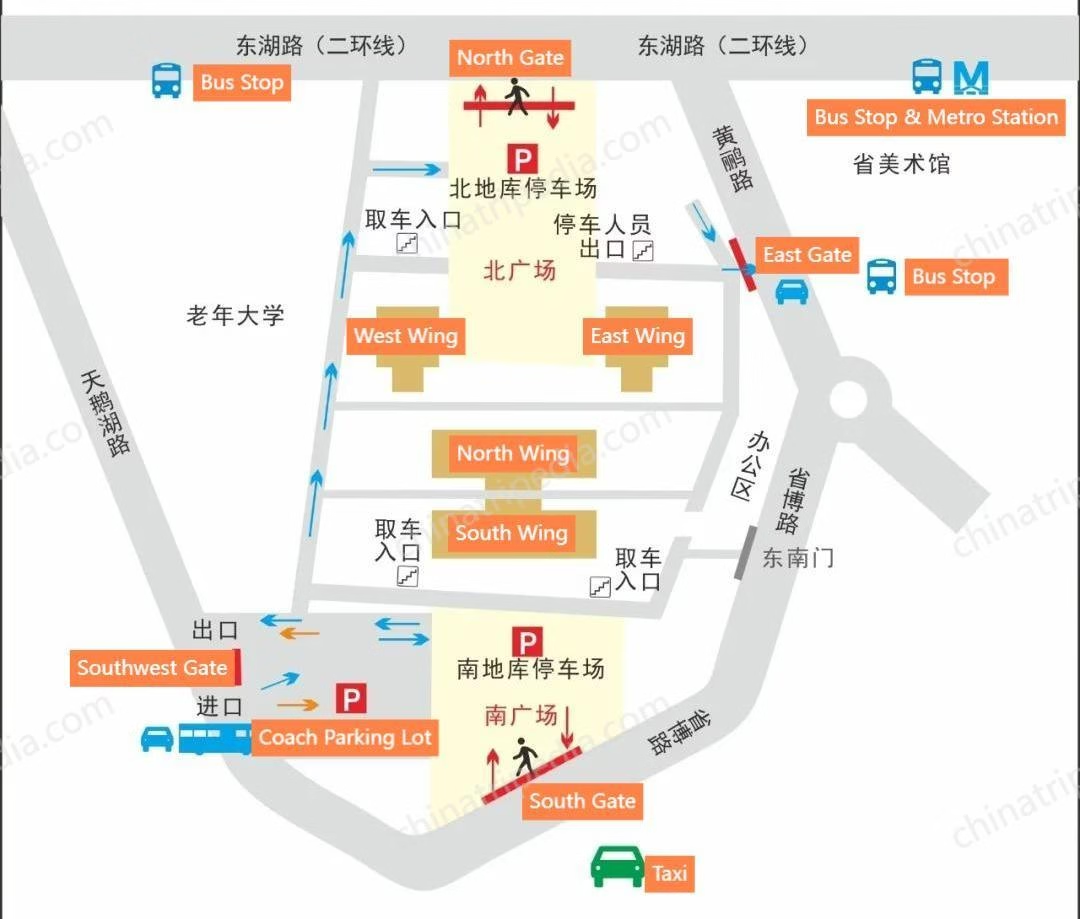
The Hubei Provincial Museum is situated on the shores of East Lake in Wuhan, Hubei Province, China. Its precise address is No. 160 Donghu Road, Wuchang District. To get there, you can choose the following ways:
Bus: Take bus 14, 402, 411, 552, 578, 701, 709, or 810 and get off at Donghu Road Provincial Museum Stop (东湖路省博物馆站)
Metro: The closest metro station to the museum is Provincial Museum Hubei Daily (省博湖北日报站) on line 8. After getting out of the station from exit D, you will see the museum right across the road.
Map of Hubei Provincial Museum
Highlights of Hubei Provincial Museum
Chu Culture Exhibition

The Chu Culture Exhibition is a tribute to the Chu State, which existed for approximately 800 years until its annexation by the Qin State in 223 BCE. From the 1960s onwards, Hubei province has been at the forefront of archaeological efforts, unearthing over 5,000 Chu tombs that have yielded a vast array of artifacts, shedding light on various aspects of Chu society. Chu culture, as a regional culture during the pre-Qin period, is a unique and integral part of China’s early civilization. This exhibition is divided into eight sections and showcases the most exquisite Chu artifacts discovered in Hubei, aiming to comprehensively showcase the brilliance of Chu culture. Among the exhibited items are the sword of King Goujian of Yue, the spear of King Fuchai of Wu, and a partially reconstructed chariot and horse from the Chu chariot pit unearthed in Jiulian Dun, Zaoyang, Hubei in 2002.
Writing History

Since the 1970s, numerous bamboo and wooden slips from the Warring States and Qin-Han periods have been excavated in various regions of China. Hubei stands out as one of the areas with the highest quantity and diversity of these invaluable documents. The “Writing History” exhibition presents these bamboo and wooden slips, as well as the tools used for writing, with the intention of providing visitors with an intimate connection to the ancient writings of our forebears.
Liang Zhuangwang’s Tomb

The Ming Liang Zhuangwang’s Tomb is a joint burial site of Zhu Zhanji, the ninth son of Emperor Renzong of the Ming Dynasty, and his concubine Wei. In 2001, this tomb was excavated, revealing 5,300 precious artifacts, including gold, jade, and porcelain. Among the treasures from this tomb is a gold ingot from the “Western Regions,” a significant piece of evidence regarding the voyages of Zheng He to the Western Oceans.
Zeng Houyi’s Tomb

Unearthed in 1978 on the outskirts of Sui County, present-day Suizhou, the Zeng Houyi Tomb dates back 2,400 years and belongs to Zeng Houyi, a feudal lord during the early Warring States period. This tomb yielded a diverse collection of over ten thousand artifacts, renowned for its quantity, variety, high value, and remarkable preservation. The Zeng Houyi Tomb exhibition showcases the most representative items from the tomb, offering insight into the spiritual world and material life of people from over two millennia ago.

The exhibition is divided into eight sections: the ancestral hall, bronzes, weapons, chariots and horses, bamboo slips, lacquerware, gold and jade artifacts, and musical instruments. Highlights include the bronze deer-shaped stand with a crane, the connected-body wine jar, the ritual vessel and basin, the exceptionally sharp dueling spears and triangular-bladed shovels, bamboo slips that contain a wealth of early textual material, and a sizable gold chalice that weighs 2,156 grams. The lacquerware and bamboo objects also stand out due to their distinctive production methods and style, different from those of the Chu and Qin cultures.
Jingchu’s Century of Outstanding Figures

In recent history, the Jingchu region has seen a plethora of remarkable figures emerge. These individuals include national leaders who steered the country, revolutionary martyrs who fought for the nation and its people, military generals who led their troops to victory, and scientific, academic, and artistic luminaries who made significant contributions to society. The “Jingchu’s Century of Outstanding Figures” exhibition showcases over 100 representative figures, including Dong Biwu, among others. Through over 200 typical artifacts, historical materials, and photographs, the exhibition offers a glimpse into the relentless struggles waged by numerous individuals of integrity and valor in Hubei’s hinterland over the past century, from the Opium War to the establishment of the People’s Republic of China.
Vlog about Hubei Provincial Museum
Useful Tips Summarized from Reviews
Entrance and Exit: You can only enter from the south gate and exit from the north gate. If you’re taking a taxi, set your destination directly to the south gate.
Bell Chime Performances: A highlight of the Hubei Provincial Museum is the bell chime performances. There are four performances daily at 10:30, 11:30, 14:00, and 15:00. Each performance lasts for 30 minutes and costs 50 yuan per ticket. The performances feature 6-7 programs using replicas of ancient instruments such as bell chimes, chimes, and sheng, creating a captivating experience. When purchasing tickets, try to select seats in the middle of the fourth row for the best effect.
Charging Facilities: There are public charging stations available in the lobby on the first floor, equipped with three-in-one charging cables. Additionally, you can rent power banks at the coffee shops on the basement and second floors.
Self-Service Luggage Storage: For small items, you can use the self-service lockers on the basement floor of the south gate for free with your ID. For larger items, you can deposit them at the south gate and have them transported to the north gate for free by staff. This saves you the hassle of returning to the south gate to retrieve your belongings.
Audio Guide Services:
- Self-guided audio tours cost 20 yuan for 3 hours or 40 yuan for unlimited use on the same day. You can bring your own round-hole earphones or purchase them on-site for 10 yuan per pair.
- VR audio guide glasses are available for 50 yuan.
Dining Options:
- Second Floor: Offers bell chime beef noodles 🍜 and mousse desserts, with average taste.
- Fourth Floor: Provides rice bowls, noodles, and more, with relatively better taste.



It’s currently the off-peak travel season, and apart from being closed on Mondays, the Hunan Provincial Museum is quite easy to book. Admission is free! Just bring your ID card or use the reservation code to enter. Remember to turn off your flash when taking photos, and it can get quite warm in crowded areas, so it’s best to wear a jacket that’s easy to take off.
The Hubei Provincial Museum is quite good. The King Zenghouyi’s bronze chime bells are really impressive, but it was too chaotic inside, like a vegetable market! You can go to the service desk to find a guide, which costs 100 yuan for a private tour.
I didn’t expect such a large crowd on Friday. I arrived at the entrance at 8:50 AM and there was a long line outside. They started checking tickets and security at 9:00, and it took about ten minutes to get in. I headed straight to the King Yue Goujian Sword and there was no line there. However, by the time I went back at 11:00, there was a long queue. On the bright side, the progress was relatively quick.
The Hubei Provincial Museum has five floors, and it’s impossible to explore it all in just one day.
We drove there and it took a long time to find a parking spot due to the long lines. I knew it would be crowded, but no one warned me it would be this bad.
Meeting King Chu Show was an experience priced at 58 yuan for adults, with a 30-minute performance consisting of 60% projections and 40% live actors. Compared to watching a movie, it may feel a bit thin, but as an experience, it’s not too bad.
It’s better to come early to avoid queuing for the Sword of Goujian [越王勾践剑]. When I came down after exploring the upper floors, the entire second floor was filled with people queuing.
The “Bianzhong Performance” is located on the B1 floor. Tickets can only be purchased on-site for 50 yuan, with a duration of 30 minutes. Showtimes are at 11:30, 14:00, and 15:00.
The creative store on the 1st floor closes at 16:30, entry to the 3rd floor passage is not allowed after 16:45, and the whole place closes at 17:00. They are very punctual and not flexible at all, so those with shopping needs should pay attention to the time. It is recommended for those who like creative products to first visit the creative store on the 1st floor to choose their favorite items before exploring further!
The chime performance is located on B1, and it is the largest and best-preserved set of chimes discovered to date, with the most complete musical scale and grandest momentum. Its excavation even reshaped the history of world music, earning it the title of the “Eighth Wonder of the Ancient World.” The chimes are quite large, and you can also watch the chime performance, experiencing the joy of Marquis Yi’s world. The sound is truly unique. Reservations for the performance can… Read more »